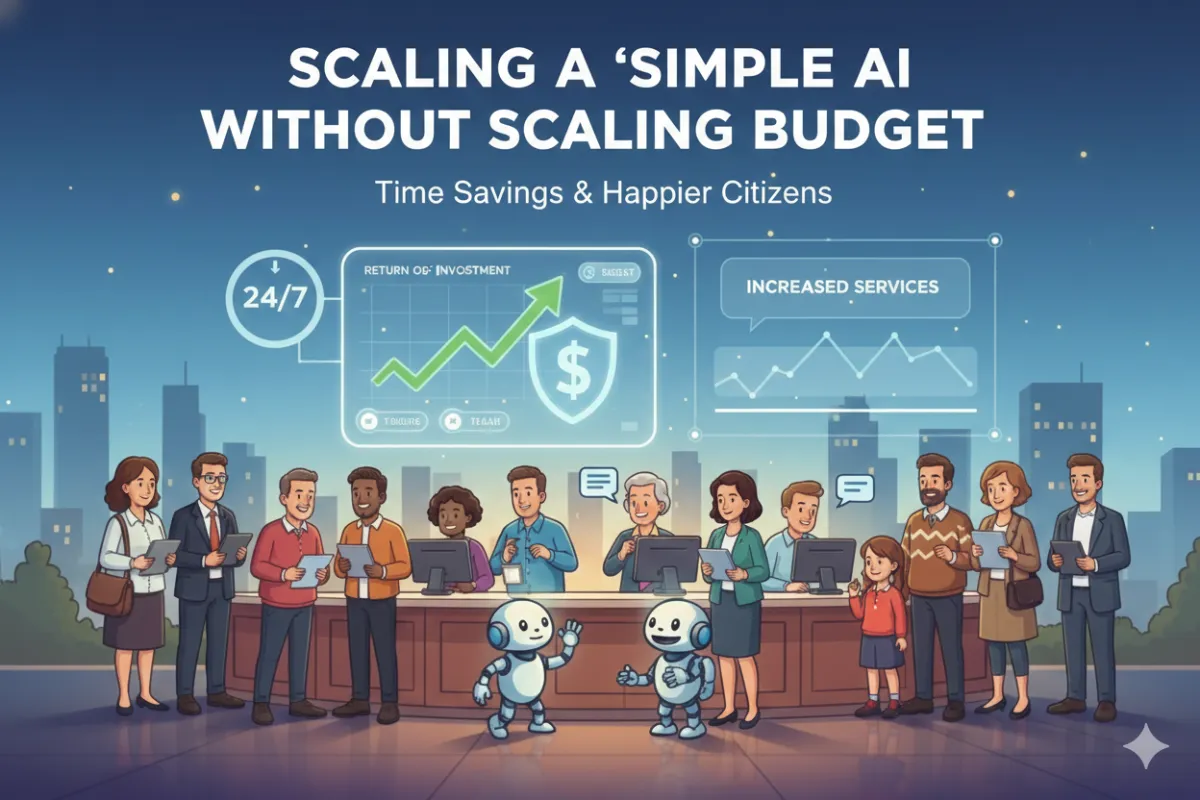
Scaling Service Without Scaling Budget: The Operational Case for Voice AI
The Service Gap Challenge
Municipal leaders are currently caught in a "Service Gap." On one side, residents expect 24/7, high-speed digital interactions. On the other, budgets are tightening, and the cost of hiring and training new staff is rising. Traditionally, increasing service required increasing the budget. Voice AI has changed that math.
Maximizing the "Human Dollar"
A significant portion of a city’s budget is spent on manual responses to routine, informational queries. Every minute a staff member spends explaining how to find a permit form or when the holiday trash schedule is, that "budgeted hour" is being spent on low-complexity tasks.
By implementing a Conversational Service Layer, municipalities can:
Deflect Routine Volume: Handle 60%–80% of common FAQ calls automatically.
Provide 24/7 Availability: Offer services on nights and weekends without the overtime costs.
Scale Instantly: During a utility outage or tax deadline, the AI scales to handle hundreds of calls simultaneously at no additional cost per call.
The Simple "Agentic Flow" for Local Gov
As shown in our Agentic Flow model, the AI acts as a filter. It doesn't replace the staff; it optimizes them. Routine "check-ins" and "inventory of requests" are handled by the agent, ensuring that when a resident does reach a human staff member, that employee has the mental bandwidth to handle complex, high-priority issues.
Efficiency Without the Tech Overhaul
Scaling doesn't have to mean a million-dollar software project. Modern AI voice agents are designed as a "plug-and-play" service layer. They work with your current phone systems and pull from your existing city-approved knowledge base.
The result is a municipality that feels larger, faster, and more responsive to its citizens, all while keeping the bottom line flat.
